Showing posts with label CAMP. Show all posts

Friday, January 27, 2012

Logo Design: CAMP@50

This year will be the University of the Philippines Manila College of Allied Medical Profession’s (UPM-CAMP) 50th Anniversary. CAMP has undergone dramatic changes from the time of its establishment in 1962 to what it is today. After 50 years since its founding, its pursuit of academic excellence and its dedication to serve the Filipino people have been the guiding pillars of the School. These goals shaped the School as one of the premier institutions in the country that offers degree programs in the professions of Occupational Therapy (OT), Physical Therapy (PT), and Speech Pathology (SP) and post-graduate programs like MRS, MRS-SP, MClinAud and MPT. And just recently, the college has finally found a new home in its own building.

As a graduate and having been a faculty member for 10 years, CAMP has been a very important part of my life. I am so indebted for the all the wonderful memories, uplifting knowledge, skills and experiences. One cannot deny that the most amazing people of the country belong and were produced by this college. Sure it is something to be called a graduate of CAMP (considering how tough it is to graduate) but where else can find a college that respects each of its constituent for everything you are, molding you not only to become the best OT, PT or SP, but allowing you to grow with your other talents as well (singer, writer or artist, or whatever unconventional skill you might have). So it was with great pleasure for me to create the seal of CAMP, and this time, to design the commemorative logo of CAMP’s golden anniversary.

Dean Cabatan sent me all the necessary information I need to work with. The theme is: “CAMP @50: Aiming Higher -- toward greater relevance and stronger leadership”. The seal and the whole text should be included in the whole logo set. One of the informal guidelines I have when creating a commemorative logo is that it should look good enough for you to wear it. And of course, when you wear a logo, it should be flashy enough for people to notice you and easy enough to identify with the message.

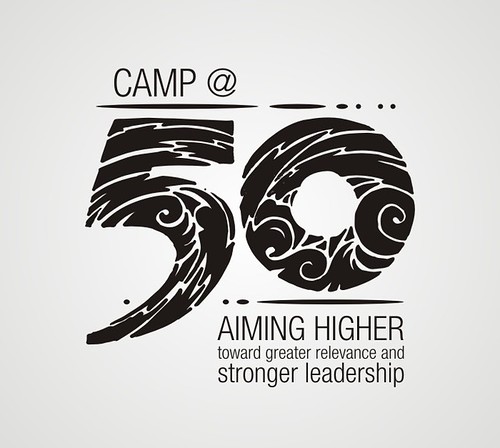
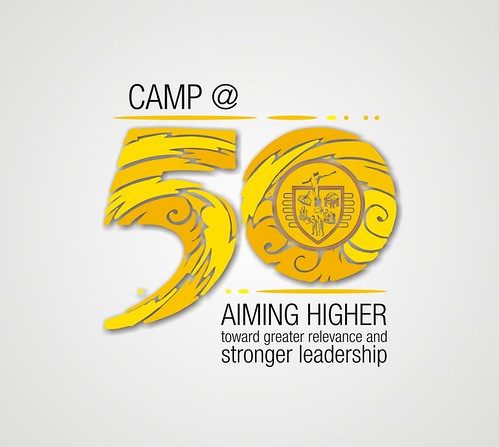
I wanted “50” to be the main highlight of the whole design, incorporating the graphical elements within its outline. Celebration was what I have in mind, and though the drawing looks random, each swirl and swoosh represents an aspect of the chosen theme. I had to keep it simple as well to facilitate printing in all forms.

IMG-20120105-00378

The CAMP seal will be conveniently placed inside the “0” and the text are placed around in simple but elegant NeueHelvetica font.

CAMP@50mono

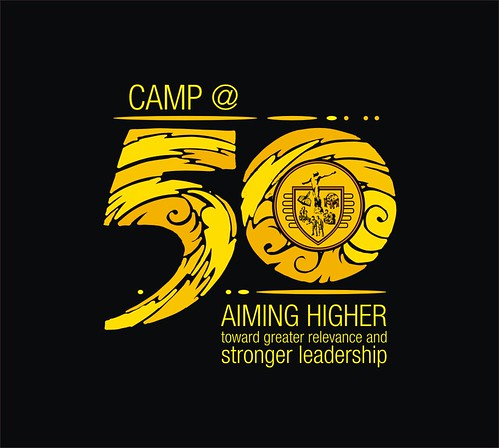
Of course, gold is the theme color, so I used different shades of yellow and orange in the logo. Good enough to wear?

CAMP@50lightv2CAMP@50blackv2

Here is how the logo might look like in shirt form (I soooo hope CAMP has the budget to make these shirts):

CAMP@50Shirt

Happy 50 years CAMP!

Sunday, September 16, 2007

On Being the Graphic Arts Expert at the Inaugural Ceremonies of Dean Cynthia V. Isaac…

I often wonder why the College of Allied Medical Professions (CAMP) of the University of the Philippines Manila is seemingly full of misplaced individuals who could have been better off pursuing other professions such as those they are truly passionate about. Individuals who study and train to be physical therapists, occupational therapists and speech pathologists and yet behind that professional façade is a uniquely talented person whose caliber in that special talent could rival those in that particular field. Singers, artists, fashion designers, dancers, painters and creative thinkers hiding beneath the white uniform or the scrubs clad with children's designs. Hmmm…

Recently, I have been charged to create the visual elements that could decorate the Inaugural Ceremonies of Dean Cynthia V. Isaac last September 6, 2007. This is by the way her second term as CAMP's dean. I didn't remember the first inauguration to be this extravagant (the need for elaborate art, VIP guests, band, etc!) but I think this is because of the pressure brought about by the inaugural ceremonies organized by the other colleges and of course, the love for grand events of the new chancellor of UP Manila despite cost-cutting measures of the university. So there it is, I have been summoned to channel my creative energies into this event. And I lost 2 days of valuable sleep for this and ended up sick a whole weekend.

Weeks before the event, I drew up some sketches for the general feel and look of the ceremonies, taking cue from Dean Jake's favorite color which is blue. I like blue, and have often used it as a central color theme in CAMP events (1996 UP Manila Lantern Parade tie-dyed shirts, 2003 CAMP Shirt, etc…) so this is a familiar color to work with. I thought about using 4 banners each with a different theme for each. The banners should be designed so that it can also be reused for future events. Blue can work well with silver or gold, but for this theme, I wanted a stronger highlight, so I chose gold to go with the royal blue. The program/invitations will also utilize this color theme.

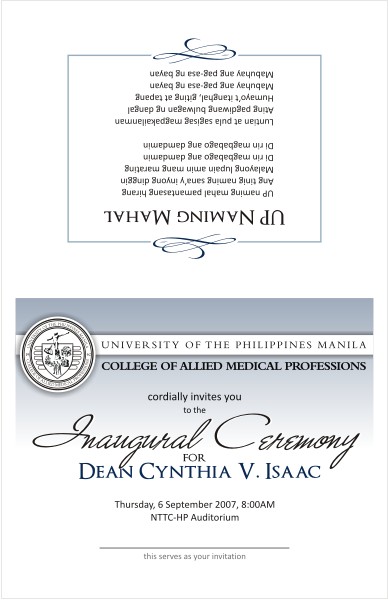
I proceeded with developing the invitation cards but it was not until the night before they should be released that the information written on them was finalized by the Central Administration of UP Manila. Because of this, a separate but larger program document will be distributed on the inaugural day itself to update the missing elements in the invitation. I will be using my own printer for this, and I wanted to be economical on the use of ink, so I employed the use of pastel and fade effects on the colored elements of the invitation cards. I used the fonts Optimus Princeps, a good free font that exudes authority and elegance and Calibri (my favorite sans serif these days!) for easy readability even at small font sizes (ergonomic fonts!).

Inauguration Invitation Front-Back

Inauguration Invitation Inside

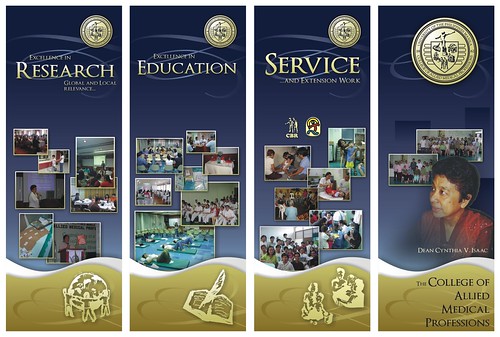
After gathering the necessary pictures from my own and CAMP's stock, I proceeded with developing the banners (5 banners all in all! 4 for the stage, and 1 to include a congratulatory message to the Dean which will be posted outside the college). The banners will simply be a montage of pictures to support the themes each banner is carrying: Research, Education and Service… which are the 3 primary thrusts of UP Manila. The last banner will focus on the CAMP constituency. Looking at these mock-ups, you will notice that I could have used better pictures. Well, my stock is focused mainly on CBR activities, and CAMP's stock is very deficient and unorganized. But, I guess with the limitations, these look fairly well. As they were finished, they were then sent to the printing station.

Inauguration Tarp Out All

I almost forgot creating the congratulatory banner, because of the stresses brought about by the 4 earlier banners, and I had to create this in 15 minutes for emergency printing. It was relatively easy, because I only had to copy and paste elements from the invitation file.

Inauguration Congratulations Banner

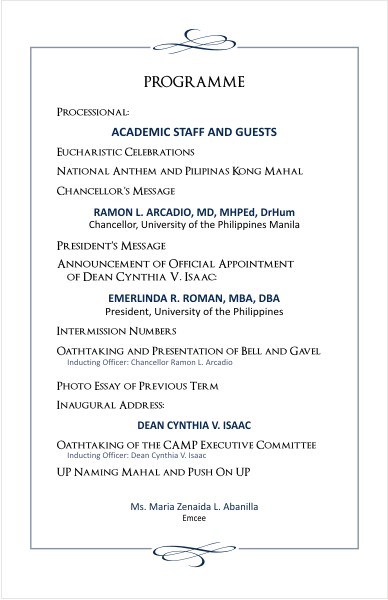
Lastly, I have to finalize the program for the inaugural day itself. Again, this was easy since the text was available, but due to format inconsistencies, I have to change the font of each word/phrase manually. Also, the text was only finalized the day before the event. I would have to print these with my own slow printer, so time was against me. This was another sleepless night.

Inauguration Program Front-Back

Inauguration Program Inside

And here are pictures from the inaugural ceremonies.

During the offertory in the Mass before the program, each department/program was tasked to bring a symbolic offering. Luckily, I was able to drop by a shop selling local handicrafts and I bought this net laden with shells. It was meant to represent CAMP and CBR's mission to bring out the best in the communities and people it is serving and training. Just as the shells in the net are of different colors and shapes, so does it recognize the unique individual strengths that each member of the community brings.

As I said, CAMPers are highly talented… "talentado" I would say. Each person is called to a certain mission, unique and special. Our talents and professions are just means to achieve our mission. My mission is to inspire faith, learning and creativity in other people… and as long as I know I'm fulfilling this mission, whether as a professor or an artist or whatever (Remember, your job or role is not your mission, and most importantly YOU are not your profession), I know I'll be happy.

Sunday, January 7, 2007

Aranzazu

Today is officially my first day of work for the year as I have finally recovered enough strength and function from my bout with bronchitis. I know it’s Sunday, but that is what being part of the Community-Based Rehabilitation Program of the University of the Philippines Manila College of Allied Medical Professions (CAMP) entails: being able to respond to the schedule and activity of the community. As most of you (CAMPers, that is) will understand, the CBR Program has been in Montalban for quite a long time already (16 years to be exact), and plans for sustainability and transition was only realized in the last 7 years. I am the lucky person designated to ensure the sustainability of the CBR Program in Montalban, Rizal (Sustainability has been defined as financial support, municipal legal mandate and setting-up of physical and organizational support structures, all of which have been more or less achieved), ensure a smooth transition to the next site, and prepare the community of the next site for the CBR Program. San Mateo, Rizal (the town before Montalban, if you take the long road) was chosen as the next site for objective (it fulfills the reqirements for an ideal community for CBR) and logistic reasons (geographic location to original site and UP Manila). I have to juggle my time with the available schedule of municipal officials and personalities, with my supervision, with my lectures at CAMP). There are times when I have to have a class in Manila, and run to Montalban/San Mateo, for a "talakayan" seminar with the locals or a meeting with a barangay captain. So you can see how difficult it is to be head of the CBR Program, and it is one of my chief sources of depression and anguish that some colleagues not only appreciate the efforts that the CBR staff puts into this noble cause, but even come to the point of poisoning the minds of students and fellow faculty members about how seemingly pointless the program is to them, based on hearsay, or their very limited experience within the program or with the staff (which does not necessarily have to be all good, but to my opinion, a bad experience or hearsay can never be used to come up with a conclusive opinion about the whole program). With this, I salute the staff, past and present, for having the heart and resolve to serve and teach amidst the atmosphere of resistance to what we do and the challenges that community work entails.

Today, we met with the new parish priest the Nuestra Señora de Aranzazu Shrine in San Mateo, Rizal, Monsignor Generoso “Henry” Mediarito, for the reason that we are seeking the support of the parish in providing the backbone of the organization of persons with disabilities (PWD’s), as the local government unit (LGU) of the municipality is ready to commit in providing the infrastructure and support people (which includes the barangay health workers, the future CBR workers and others), that is, providing the service aspect (rehabilitation and community education) of CBR. The municipality, in my prior meeting with their new mayor, Ariel Diaz and the municipal health officer, Dr. Sochaco, has already agreed to the establishment of the CBR Program. The site of the CBR headquarters has already been identified and the barangay health workers are ready to be mobilized for survey and other preparation purposes. It is perhaps providence that Mnsgr. Mediarito is a very close friend of my parents, and has had prior experience with PWD’s in Tahanang Walang Hagdanan (which he aimed to integrate within parish activities when he was parish priest of Cainta, Rizal) that our meeting went along very smoothly. He was more than willing to institute the proposal within his parish, that he had already set this as an agenda in the next pastoral council meeting. So far, the social preparation for the next site is going smoothly.

One of the things that struck me in our meeting with Mnsgr. Mediarito was his resolve in changing the religious attitudes of the parishioners in San Mateo. He noticed that the parishioners seem more focused on the external manifestations of their religious practice, these are the ceremonies, the costumes and the regalities of the festivities and prayer activities, rather than the internal spiritual manifestation of faith. He confessed to us how sometimes he, as a parish priest has oftentimes been misunderstood and misinterpreted by his parishioners. He had to remove all the “bongga” activities whenever he discovered that these served more as obstacles to spiritual growth rather than supported it. It should be understood however that some of these “traditional” activities have been part of the Filipino culture that the parishioners have grown to be familiar with. (Thanks to our Spaniard colonizers, who have ingeniously transformed the ancient Filipino animistic beliefs to Christian devotions to ease the natives into the faith. Local historians even claim that some antique Sto. Niño statues were carved from “anitos”). There’s nothing inherently wrong with these activities, images or representations of the Christian faith, especially if these help enrich one’s spiritual experience and helps deepen one’s faith. However, it is an entirely different matter when these become the primary foci in one’s practice of faith (which has become one of the major critiques of the Catholic faith). Monsignor Mediarito further discusses that the activities that we organize, the things we do should always reflect a worthy goal, benefiting individuals and the community in the long run. According to an example he provided, we do not hold religious processions along public streets wearing white garbs to be seen by onlookers in the hope that they will be held in awe by its beauty and extravagance. We participate in these processions to be reminded of the virtues and values that these originally represented. Some individuals, we will realize (and this does not only happen in San Mateo, Rizal), during the feast days of their towns, will be so involved and invested in the preparation of the festivities that they forget the real meaning why these feast days are celebrated at all.

I realized that this extends beyond the religious domain, and pervades even other areas of our lives, workwise even. How often do we organize or participate in events for the sake of fulfilling an obligation or expectation, of trying to outdo other people and be recognized and be worthy of fame and praises, or of proving a point to embarrass other people? Sometimes we cover this, rationalizing that these actually fulfill a noble goal. It seems that we already live in a Machiavellian world, too focused and demanding in quantifying the results and looking good, that we have grown blind to the real purpose and mission of our work, our organizations and our lives.

This is indeed a great challenge especially for those involved in community organizing, an indispensable aspect of our work in CBR. As supervisors, we guide our students, interns and CBR workers in designing and organizing activities through a participatory process (which involves needs assessment and planning involving the stakeholders). But oftentimes, we notice them doing these things out of an “obligation” since this is expected of them, or for the “reward” of getting a good grade or approval, or even for the “competition,” that they will outperform the other groups. Sometimes, we have organized programs and activities for the main reason that the community will enjoy this and have fun, that we will look good and more likeable. There have been some activities and programs that have been implemented which when closely examined have been designed for things other than the objectives and beyond the mission of the program. Soetimes, these have even been cleverly “giftwrapped”, appearing to be fulfilling the objectives. But impressively, there were others which were honest to their purpose, implemented by proponents who were truly sincere in their work. It is indeed important that we be more conscientious when we plan activities or design programs.

With the lessons gained from the success and failures in Montalban, we'll be able to successfully establish and implement CBR in San Mateo, and in the future, adaptation in Rizal province and others. With this, we hope that the transition to San Mateo will be untroublesome and painless.

By the way, "Aranzazu" means “abundance of thorns” in Basque/Spanish...